Tampilkan postingan dengan label Genius. Tampilkan semua postingan

Jumat, 04 Mei 2012

iPhone 4 Portable Genius

Ebook Download | iPhone 4 Portable Genius | The book iPhone 4 Portable Genius by Paul McFedries has been like a non judgmental friend over the past couple of weeks as I'm learning the functions and features of my new iPhone. It's like getting inside tips from a computer savvy teenage kid without the eye rolling and sighs. The book is written in a casual and non technical style. There are plenty of helpful graphics and screenshots. Each chapter heading is a questions that I've asked myself such as "How do I configure my iPhone," "How do I max out my iPhone's photo and video features," "How do I use my iPhone to navigate my world," and "How do I keep my life in sinc with Mobile Me?" to name a few. I've run across some simple tips that I'm sure I would not have discovered on my own, like tappping on a phone number embedded in a text message or web page to initiate a call, and some keyboarding shortcuts, and I finally understand the ins and outs of all the internet access networks. The book is handy and compact. It is one of a series of "Portable Genius" books for Apple users. This book may be too basic for experts, but for me it was definitely worth the read.



Rabu, 25 April 2012

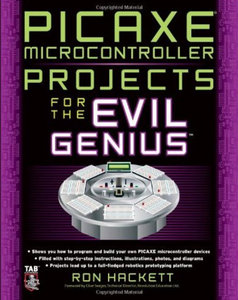
PICAXE Microcontroller Projects for the Evil Genius

Ebook Download | PICAXE Microcontroller Projects for the Evil Genius | Mr. Hackett did a fine job on this book. It is well written, very illustrative (although the publisher could have lightened a number of the illustrations, many were very dark and you had to squint), and follows a very nice outline.
What impresses me the most, besides the thoroughness of the programming information, is the design suggestions that he made. I have, since I was 10 years old (I still have that first breadboard 25 years later), been a breadboarder. I have built and modified many circuits on breadboards. It is a valuable skill, one that can only come from experience... but it can also get tedious. That's why I really like the development boards that are available. I have been using a PICAXE development board (google AXE091) for a few days and really enjoy it, and highly recommend it. It's also why I REALLY like the Arduino with the associated shields for it. But what impresses me with this book is Mr. Hackett's stripboard techniques. First you breadboard a peripheral (LED display, switch, etc) and then, since it is something you will likely use again and again, you can save time in the future by making a stripboard version that plugs into your breadboard. Very nice. But even that can get tedious after a while... so guess what? When you have developed that particular skill, and want to save time, you can actually purchase professionally etched PC boards from his website to make some of these peripherals.


Minggu, 18 Maret 2012

Pursuit of Genius: Flexner, Einstein, and the Early Faculty at theInstitute for Advanced Study

Ebook Download | Pursuit of Genius: Flexner, Einstein, and the Early Faculty at the Institute for Advanced Study | The amount of sheer intellectual might that resided at the Institute for Advanced Study in Princeton during the early years is extraordinary. The scientific equivalent of a rock star, Albert Einstein, was of course the original prize, yet Kurt Godel, John von Neumann, Oswald Veblen and others also added a great deal. This book is an extremely detailed look at the founding of the institute, the reasons why it was created and the difficulties encountered as it moved from idea to reality.
The level of detail that Batterson presents is amazing. There are records of salary negotiations; internal disputes over how the Institute will be managed and the personal political disputes that seem to be an inherent feature of academia. Given the political and economic conditions of the times, some of these problems are understandable. Hitler was on the rise in Europe and many of the best minds were fleeing the continent for safer areas. The great economic depression had taken hold and despite a great deal of effort by the political leaders, it continued to linger and no one seemed to have an answer. Therefore, it is a tribute to everyone that the Institute was founded and so many great minds were collected in one place.
One of the more interesting points is made at the end of the book. Nobel Prize winner Richard Feynman declined a position at the Institute. He preferred to stay at a university because he believed that the lack of contact with students and new ideas was a detriment to progress. There is some merit to that; few really new ideas have emerged from the people at the Institute after their appointment. Batterson has a counter argument, noting that these are people whose appointment was based on them having had one or two truly outstanding ideas. To expect them to have a few more after that is perhaps asking too much of them.
As a consequence of the level of detail this book is at times a tedious read. If you are interested in the overall view of the Institute then you will often find it uninteresting. However, it is the definitive history of the Institute for Advanced Study, so on that basis it must be given the highest possible praise.